
How do you take your tea? With milk … or without? This isn’t the debate about whether milk goes in first or last. That is a topic for a different day. This discussion is about why are we adding milk to tea at all! Many people would never think of having a cuppa tea without adding milk. For me, it can vary. If its a cold, rainy day and I need a hearty Assam, then, definitely ‘yes’. Otherwise, I’ll take my tea — green, black, or white — as is. Steeped perfectly with no milk or sweetener. There are many theories as to the origin of adding milk to tea, but would you like to know the REAL story?
Let’s start at the beginning …. as we all know, tea originated in China about 5,000 years ago. And contrary to many beliefs, adding milk to tea actually began in China. Over the centuries, tea evolved in its processing and in its enjoyment. Although written documents do not go back quite that far, we do know that in the beginning tea leaves were pulverized into a paste and used primarily for medicinal purposes. By the 8th century, however, tea became much more ceremonial and reserved only for nobility. The Imperial Court started enjoying its tea pulverized and prepared by boiling in hot water.
 By the 12th century, the preparation had changed again as tea continued to be pounded into a powder, but now it was frothed up in hot water before serving. A method that found its way to Japan and is still practiced today. As Japan was embracing this style of tea preparation and enjoyment, the Chinese Imperial Court once again changed the way they prepared tea. Now preparation was to infuse the whole tea leaves in water, just as we make tea today. The pressed powder tea vanished entirely from Chinese tea culture (not from Japan). But when did milk come into play?
Across northern China, along the Mongolian and Siberian borders, lie the Wuyi Mountains, where it is said some of the best teas originated. The tradition of adding dairy to tea was actually invented by people who live in this stark, frigid landscape.
During ancient times, as a means of preservation, tea was compressed into blocks or bricks. The leaves, either whole or pulverized, would have been pressed into molds to shape them, and then left to dry until all the moisture was evaporated. The bricks themselves were very primitive and could take on many different sizes and shapes … over the years some of the molds became quite decorative and elaborate. These tea bricks were also traded as a form of currency (but we’ll leave that discussion for another day).

The Mongols from the north had no use for the Chinese and from the days of Genghis Khan in the 13th century, began conquering this vast region. As the Vikings did when conquering Great Britain, the Mongols traveled with their nomadic families, subsisting entirely on the meat and the milk from their herds. These new rulers of the land drank this coarse dark brew made from the tea bricks. They enriched the brew by adding the fermented milk from their mares and yaks.

Enjoying yak milk tea and tea balls in a yurt in Mongolia.
To prepare the tea, pieces of the bricks were broken off, boiled with water or milk, and then mixed with butter and a little salt, making it a healthful, filling beverage. This style of tea preparation with its high fat content, was needed for people who faced the brutal climate of this region. Many times the cooked tea leaves would then be formed into balls and eaten as food. Both of these styles of preparation continue today.
 By the 17th century when the Manchu tribesmen began moving down from the north to retake their country, tea growers were already selling teas … to the Dutch. Once again, contrary to popular beliefs, it was the Dutch who began buying tea and introduced it to Europe … not the English. Although Portuguese, Italian and Spanish explorers tasted tea and wrote about it, it was the Dutch who began the tea trade. The Dutch East India Company was formed in 1605 and began trading with China, bringing the tea leaves to Amsterdam. In 1655, when the Dutch ambassador travelled with the Company to the port city of Canton, he documented that milk was “given with his tea”. This is the first evidence of Europeans adding milk to tea.
Tea was known in France by 1636, but didn’t enjoy a big following. In Russia, tea was given as a gift to Czar Michael in 1618, but he rejected it. Tea also appeared in Germany around this time, but also wasn’t widely accepted. But, when tea first appeared in England thanks to Portuguese Princess Catherine de Braganza, aristocrats took to it immediately. It was through coffeehouses in England in the 1650s where tea first appeared publicly. From there it was introduced to the British colonies in America.
 When tea was introduced to Britain in the middle of the 17th century, it was green tea from China … gunpowder green, served without milk. But, by the 1720s, although very expensive, black teas from China had taken over in popularity and were outselling green teas. And it was not the best quality, so adding milk to the cup just made sense. And that’s when British tea drinkers began adding milk and sugar for enjoyment.
As Sam Twinings, director of R. Twinings and Company, says: “There is no doubt tea is, on the whole, improved by milk. It smooths the taste, and is often referred to as ‘creaming’, giving a more pleasant, gentler, softer result. Teas like Gunpowder, Green and Jasmine, however, are not good with milk. Assam type teas cannot be drunk without it.” I couldn’t agree more!
~ ~ ~ ~ ~
References: Siam Teas, Teapedia, Wikipedia, Harvard Business School, That’s Mandarin, Atlas Obscura, Teasenz
____________________________________________________________________________

 With his entrepreneurial spirit, William approached his landlord, Mr. Mason, with a business proposition to jointly open a store selling the candles and groceries. They chose the then less affluent Mayfair section of London, a section still undergoing rebuilding and it was there in 1707 that they opened their small store. Fortnum used his palace connections to drum up business and working closely with the
  pork pies, poultry in aspic, dried fruits, marmalades and jams, to their affluent customers. One item, which the newest Fortnum created, became immediately popular, the “
 Since that time, Fortnum & Mason have sent hampers to every part of the world … from base camps on Mount Everest to the battlefields of Iraq. When Napoleon said “an army marches on his stomach”, I wonder if he knew that Fortnum & Mason was supplying the British officers with food and supplies. The Napoleonic War lasted from 1799 to 1815 and during that time officers in the British army would order specialty food items, dried fruits, preserves, pates, so that they wouldn’t have to suffer the hardship of war.
 Of course, they wouldn’t be the iconic store they are without serving Afternoon Tea, which they have been serving for centuries. The original St. James room was completely refurbished in 2012 in honor of the Queen’s Diamond Jubilee.


 All tea comes from one plant, the Camellia Sinensis. The Camellia Sinensis is an evergreen plant, which resembles its cousin, the azalea bush. Yes, there are over 3,000 varieties of this plant, but it still is the leaf of this plant which, after plucking, withering, firing and sorting, gives us “tea”.

 Black teas are sold as “orthodox” (large, unbroken leaves) or as “ctc” (smaller particles called “cut, torn, curled”). Black teas can be from a specific estate or blended, as in English Breakfast, or flavored. The most popular flavored black tea is, of course,
  Is caffeine addictive? Research says “no”, but caffeine does stimulate the nervous system and most of us do crave that alert feeling that comes after having it. I believe it’s better to understand the caffeine content in a cuppa if we start with coffee …

 One of the most memorable places I had the privilege to visit was Darjeeling in India. Yes, Darjeeling is a tea, but it is also a place. “The Land of the Thunderbolt” or Dorje-Ling is what it is called in Tibetan. Situated in the northeast corner of India, high in the Himalayan mountains and bordered by Tibet, Butan and China, this is a place of magnificent beauty. With its slightly acidic, but rich soil, abundant rainfall, high elevation and afternoon cloud cover, its no wonder that some of the best teas in the world are grown here. Known as the “Champagne of Tea”, Darjeeling teas can command some very high price tags.

 The history of tea in this area goes back to the early 1800s when the
  Authentic Darjeeling tea is unique and cannot be grown or manufactured anywhere else in the world. And now Darjeeling tea has a ‘Protected Geographical status’ within the European Union, USA and Australia. As Roquefort is to cheese and Champagne is to wine, Darjeeling now is to tea. These products with their individual characteristics specific to the particular region in which they are produced have been awarded a certificate protecting them from exploitation. Consumers knowing this can now be guaranteed that they are getting genuine Darjeeling. This helps in ensuring the production and sale of Darjeeling tea all over the world. And to identify authentic Darjeelings, a logo was also created showing the profile of a woman holding two leaves and a bud.


 Here are a couple of ideas for you. For a dry rub, mix one tablespoon salt, 3 tablespoons each of brown sugar, paprika and Lapsang Souchong with 2 teaspoons black pepper and ground cumin. Grind them all in a mill and keep in a closed jar in the cupboard until you’re ready to use. Or try infusing olive oil with this tea to be used in marinades or to dress vegetables or fish – 2 teaspoons crushed Lapsang into 4 oz. of olive oil, let sit for a week or two and then strain out the tea leaves. Wonderful!
 I love all things tea … from the origins of the leaf to the ritualistic preparations, the variety of ethnic traditions, as well as the fascinating accoutrements. For preparation, the simple unadorned, unpretentious Brown Betty is one of my favorite teapots. I know its a name that is familiar to a lot of tea drinkers, but I wonder if anyone knows how this modest, round-bellied pot got its name and why some devout tea drinkers think it the only vessel worthy of steeping a perfect cuppa.

 During the Victorian era, every affluent household had servants. In the grander homes, there were servants who worked “downstairs” and servants who worked “upstairs”. The “downstairs” servants generally were not known by their name and were usually referred to by their job, “cook” or “boots”, but the “upstairs” servants were well known to the lords and ladies of the house and would probably be referred to by a ‘nick name’. MaryJane would become “Mary”. Abigail would become “Abby”. Elizabeth would become “Betty”.
 By the mid-1800s, with many Staffordshire Pottery factories producing them, the teapot had evolved somewhat and became considerably more affordable. And by 1926, it was estimated that the industry was producing approximately 500,000 Brown Betty Teapots per week … making it the most popular, widely used teapot in the country.
 Legend tells us that more than 5,000 years ago, the Chinese emperor, Shen Nung, was sitting under a tree in his garden boiling water when the wind picked up and leaves from the tree drifted down into his pot. Intrigued by the fragrant aroma and beauty of the golden liquid, he drank the infusion and enjoyed it. Tea has played a vital role in the Chinese culture ever since.
 Why is this important? Because China is a very large country, with different languages spoken in different regions, and depending upon the port from which the tea was shipped, is how this beverage got its name.
 The southern trade route, which was discovered by the Portuguese in the 15th century, actually introduced England to tea. This dangerous and long voyage traveled from China through Java to Europe around the Cape of Good Hope up the coast of Africa to Europe. It was these very same Portuguese and Dutch traders who first imported tea … “te” … into Europe. Regular shipments of “te” had begun reaching England by 1610. And with the use of Clipper ships, traveling at over 250 miles a day, the race was on.

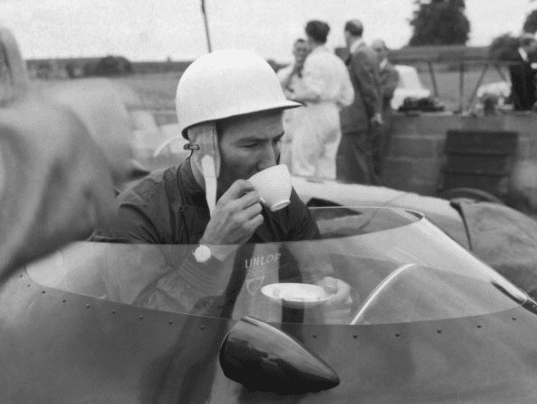
 Over the years I think many other companies have tried to target the male-tea drinker, in the hopes of building that base. The only product which appears to have gained mass appeal is the ready-to-drink iced tea market. Arnold Palmer certainly has crossed the gender barrier with his now hugely popular iced tea line. Lipton has tried over the years with lesser success with Dallas Cowboys quarterback, Don Meredith, as the spokesperson.