
In many languages “cha” or “chai” is the word for tea. Chai, or Masala tea as it is called in India, is that milky, spicy, sweet, hot beverage we’ve all come to love. Knowing the humble origins of chai, I’m amazed when I go to stores like Home Goods or TJ Maxx or even Ocean State Job Lot to see ‘chai‘ in shelf-stable packages, pre-made and ready to drink. Actually I shouldn’t be surprised at all. As much as we might love this spicy beverage, we’ve become a country in which we are so busy, we don’t have time to sit, relax and enjoy the process of … making chai, baking bread, growing herbs . I’m one of those people, however, who tries to make time for it all.
I find the story of how Chai began quite fascinating, because it tells the story of tea … with all its grit, espionage, smuggling and deceit. Chai has one of those sordid origins where it was bred out of necessity, much like soul food. People had to eat (or in this case, drink) what was available. If they didn’t they went hungry, and in most cases, they would die.
Let’s start at the very beginning. It was 1848 and the East India Company had lost its monopoly on the China tea trade. The Chinese were resentful that Britain attempted to addict their entire nation to opium and refused to do business with them. The whole of Great Britain was now demanding “tea” and It was imperative that the British government establish its own independent tea supply. But where and how?

Among botanist Robert Fortune’s tasks in China was to learn the procedure for manufacturing tea, as shown in this 18th century tea plantation. (The Granger Collection, New York)
A Scotsman by the name of Robert Fortune, curator and botanist of the Royal Horticultural Society, was asked by the East India Company to go on a “tea-discovery” mission to China. Little did Fortune know that he was about to become an international man of espionage. For three years, disguised as a Mandarin, Fortune visited the most famous tea districts, kept meticulous notes on the soil, the pruning, plucking and manufacturing process, and systematically collected seeds and plants. By 1851, Fortune had amassed such knowledge, and plants, that he filled four vessels sailing from Hong Kong to Calcutta with thousands of plants, seedlings and had hired a team of experienced Chinese tea workers.
While Robert Fortune was busy collecting specimens, Robert Bruce, a fellow Scotsman, was meeting with one of the chiefs of the Singpho tribe in Assam, India. The Singpho tribe, as the Chinese and other tribes in Southeast Asia, had also been making tea for centuries. A tea committee was immediately formed to explore the possibilities of growing tea in this Assam region, which lies just to the west of China.
And then the takeover began. Britain appeared to align themselves with the tribes, but their intent was to take over this territory. They began by moving into this area and stripping the tribal people of their land, and then increasing the land tax to the point where the Assamese were unable to pay it. This forced the Assamese to work clearing their own swampy, mosquito-laden land for the future tea gardens of their new British land “lords”.
 These indigenous people had no experience laboring in this manner, and under deplorable working conditions. The British viewed them as “lazy, indolent and miserable”. As a result, the British began “importing” labor from other parts of India. This “importing” of labor was, in fact, slavery. Recruiting agents were sent into rural areas and promised a good wage and better life to men, women and children … ‘recruits’ who willing to immigrate to Assam. When they had enough ‘recruits’ from one area, they loaded them onto overcrowded boats with appalling conditions for the six- to eight-week trip up the Brahmaputra River. Many of the men, women and children, or ‘coolies’ as they were called (the term ‘coolie’ is believed to originate from the Tamil word for wages, ‘kuli’), died from cholera, dysentery, malaria or typhoid fever. The ones who did survive were put to work no matter how sick, hungry or tired. They were managed with whips, lived in pitiful huts, were chronically ill and malnourished, and unable to escape.
 Most often the only source of nourishment for the ‘coolies’ was rice and tea. No, not a good quality tea, but tea made from the dregs of the pluckings, infused with some milk for nourishment, sugar for energy, and spices to cover up the bad taste. As a result, coolies suffered a very high mortality rate. Between 1863 and 1866 half of the 84,000 laborers brought into this area died. As I said, the history of “tea” and this now-beloved drink isn’t the sweetest tale. Many thousands upon thousands of people died from malnourishment, disease and mistreatment.
Born out of necessity, today “chai” is the national drink of India. From sipping chai in someone’s home, while making a purchase in a shop, at a train station, or on a street corner, you can’t visit India without experiencing this unique culture. Chaiwallahs are on every street corner in every village and town, ready to serve you a small cup or glass of this wonderful beverage. Each may have their own special recipe or preparation style, but rest assured, each is as delicious as the next.

Everywhere in India there are chaiwallahs on the street with large kettles selling their spicy tea steeped with boiled milk and sugar. Because of the stiff competition between chaiwallahs, each tries to develop a unique style.
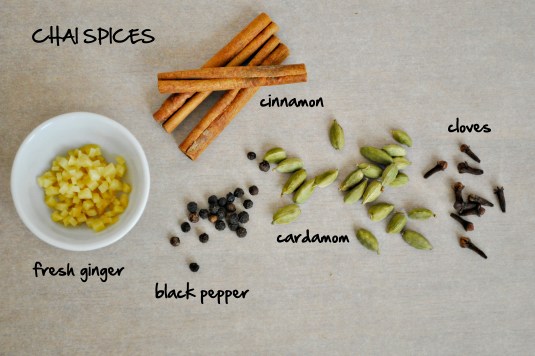
While specific recipes can vary, the black tea is always brewed with a blend of spices, generally cinnamon, cardamom, pepper, ginger, and cloves, with the addition of milk and sugar or honey. In the U.S., some folks steep their tea together with milk, spices and sweetener. Others steep the tea and spices together, then add the milk and sweetener. A third group steeps the tea, stirs in the sweetener, and enjoys it without milk. It’s your choice.
We enjoy ours best steeped in a saucepan for 10 minutes or more with equal parts water and milk and one teaspoon of tea, spices and sugar for every 8 ounces of liquid. Milk may burn if the heat is too high, so steep the heat at a medium temperature for about 10 to 15 minutes. After steeping, strain into a pot, and enjoy.
 Yes, making it yourself does take about 15 minutes or more, and you can certainly buy prepared chai in bottles or packages, or even dry chai mixes, but taking those 15 minutes is so worthwhile. And, if you make too much, just put it into the refrigerator and enjoy it cold the next day, over ice, or reheat it. In the summertime, I love to make chai shakes … with a scoop of vanilla ice cream in the blender. Try it. It’s absolutely delicious!!
I may occasionally order a chai (notice I didn’t say “chai latté”), in a café, but I really enjoy making it at home. The aroma of those comforting spices steeping in that dark, rich tea just relaxes the senses and puts me in that “happy” place.
~ ~ ~ ~ ~
References: TEA by Roy Moxham, The Heritage of Indian Tea by D.K. Taknet, For All The Tea in China by Sarah Rose, Academia, Teatulia, Smithsonian
_____________________________________________________________________________

 How about bacon, avocado and poached egg on toast … or a garlicky ricotta cheese and English peas spread with a hint of lemon … or a thick slab of roasted turkey breast smothered in pan roasted drippings (yes, I used to have that same lunch sitting at the Kresge’s counter with my grandmother) … or Nutella and banana slices, a sprinkle of pecans and topped with Marshmallow Fluff under the broiler all melted and gooey? My ‘toast’ would not be thinly sliced, pre-packaged white bread. It would be crusty, thick slices of artisanal breads from sourdough to whole grains.
 The word ‘toast,’ in fact, comes from the Latin word tostum, meaning to scorch or burn. It is believed that 5,000 years ago Egyptians used ‘toasting’ bread was a way of preserving it. (Not quite sure how researchers have been able to determine that time line.) Romans also preserved bread by toasting it, and this continued to be spread throughout Europe. The British really took to ‘toasting’ (what goes better with a cuppa?). And, of course, anything that was popular in Europe found its way to the Americas. Cutting slabs of bread and roasting them on an open fire sounds intoxicating and romantic to me.
 st invention of all time, although sliced bread wasn’t invented until 1928. I’m not sure how popular it was, having to lay your bread against the coils and and watch it, quickly taking the bread off before it burned. It wasn’t until the 1920s when the electric toaster as we know it today was perfected, evolving into a two-slice, pop-up device with a timer. And with the invention of pre-sliced bread, the world was changed forever.


 Historians have been able to trace the origins of “Chocolate”, which is the result of roasting the ground beans of the cacao plant, back to as early as 1900 B.C. in Mexico, Central America and South America. The Mayans and Aztecs used the pulverized seeds of the cacao plant, together with water and chili pepper, to brew ceremonial drinks. They actually believed the cacao bean had divine and magical properties, which made it suitable for use in the most sacred rituals of birth, marriage and death. The word “Chocolate” comes from the Maya word “xocoatl” which means “bitter water”.
 It’s hard to know who to credit in the mid-16th century with introducing Spain to the cacao bean and the “hot beverage” that was made from it. Was it the explorer Christopher Columbus, the conqueror Hernán Cortés, or was it the returning missionary Dominican friars? Whoever it was certainly made an impression on the Spanish court. This hot, bitter beverage made from the pressed blocks of dried cacao beans and hot water became a hit with Spanish aristocracy, but only after they began adding honey or sugar to it. They found it most enjoyable when mixed with milk and flavorings such as vanilla, cinnamon, ground cloves, allspice and chilies.
 Back in England, it was an entrepreneurial Frenchman now familiar with this wonderful elixir who, wanting to elevate the chocolate experience in London, removed it from the bawdy coffee house atmosphere and in 1657 opened the first “chocolate house”. As always, the wealthy elite were the only ones who could afford this luxurious experience. Tea was very dear, selling at
  h paved the way for the solid chocolate we all know and love. This also resulted in making chocolate affordable to everyone. And in 1830, J. S. Fry and Sons, a British chocolate maker, is credited with making the first solid, edible chocolate candy bar.


 When I go to one of these take-away cafes, I know I’m going to have to compromise on the quality of the tea that I’m about to order. I love green tea, but I know it will be a teabag of questionable quality, steeped with water that is far too hot and, if I don’t tell them to please not put the teabag into the cup, it will definitely be oversteeped and bitter. I will carry the cup, perhaps on a tray, back to a table, which may or may not be clean, slopping most of the tea over the top, only to find that there’s no chair available, and napkins are nowhere in sight. (Sigh)
 And the media tells me everyone is so concerned about their calorie and sugar intake, yet many Brits now consume these beverages regularly. Action on Sugar, which is a group of specialists concerned with sugar intake and its effects on health, analyzed 131 hot drinks and found Starbucks, Caffé Nero and Costa to be among the worst offenders.

 The reader begins reading from the rim down. The rim signifies those events happening soonest, while the images closer to the bottom will be further in the future. The tea leaves which settle closer to the cup’s handle suggest home and family.
 I’ve been to many tea rooms which offer Tasseography, as well as Tarot card reading, Palmestry and other forms of seeing into the future … all of which I find absolutely fascinating. Whether I believe it or not certainly doesn’t take away from my enjoyment of, not only the tea, but the experience. For a fun afternoon, I recommend visiting a tea room where they have Tasseographers and enjoying a little divination from the leaves.
 I’m not the only one saddened to see this award-winning British TV series end. It’s been six years of pure joy and escapism. For the past six glorious years, we’ve been transported to the opulent ancestral home of aristocrats Robert, the Earl of Grantham, and his wife, Cora, Countess of Grantham and their daughters, Mary, Sybil and Edith.
 ely loyal Mr. Carson, butler to the Earl of Grantham, manages the house and staff with discipline, integrity, and on occasion, patience. His stern demeanor masks the soft, squishy teddy-bear interior that we all know exists. Firmly planted in the traditions of the past, Mr. Carson painfully and slowly must adapt to a new age.
 the stairs. And, of course, the Dowager Countess, matriarch of the family, mother of Robert and grandmother of Mary, Sybil and Edith, who is an absolute joy to watch. Proud, loyal and schooled in the old traditions, she never lets impropriety get in the way of her sharp tongue.


 Glasgow at the turn of the century was riddled with problems … industries were closing, slums were prevalent, and overcrowding was a huge problem, followed by diseases like cholera and typhoid. Social centers were male dominated pubs serving coffee and ale, where politics was always the conversation of the day. Glasgow was also the center of the temperance movement and political tensions were high!


 Use one teaspoon of tea for each 8 oz. cup. An 8 oz. measuring cup is not the same as a teacup. Teacups are usually 5 oz. Mugs are usually 12 to 14 oz. All the more reason to use a teapot for accurate measurements. A three-cup teapot uses three teaspoons of tea. What is the capacity of your teapot? Just get a measuring cup and find out.
 Again, please remove the infuser or the teabags from the teapot or cup. Don’t leave them in the pot or your tea will oversteep and become bitter. Do you take milk and sugar with your tea? Feel free. Now relax and enjoy!


