
Would you believe the Queen of England and I have something in common? Yes, we do. And it is that FORTNUM & MASON is our favorite grocery store. Yes, this extraordinary store selling some of the most exclusive and expensive items in the world, is a grocery store. And my favorite! If you’ve ever visited London, hopefully, don’t just visit Harrod’s, put a trip to Fortnum & Mason on your ‘must’ list too. You will not be disappointed.
It all began with the Great Fire of 1666, which set all of London ablaze. As established builders, the Fortnum family moved to London to help with its rebuilding. A young cousin, William, arrived with the family, renting a room from Hugh Mason, a livery stables keeper, while he took a job as footman in the palace of Queen Anne. Queen Anne insisted on fresh, new candles each day, so when the royal courtiers retired at the end of the day, William had to replace the candlesticks of the half-used candles with fresh ones. Rather than throw them away, he took the candle stumps back to his room where he melted them down, replaced the wicks and created new candles. He would then sell the ‘new’ candles to the chambermaids and household staff, making a tidy profit.
 With his entrepreneurial spirit, William approached his landlord, Mr. Mason, with a business proposition to jointly open a store selling the candles and groceries. They chose the then less affluent Mayfair section of London, a section still undergoing rebuilding and it was there in 1707 that they opened their small store. Fortnum used his palace connections to drum up business and working closely with the East India Company, began to sell imported teas. A short two years later, this little grocer had outgrown their original location, moving to where they still are today.
The entrepreneurial spirit continued with William Fortnum’s grandson and namesake, also William Fortnum, who took over the business fifty years later. The relationship with the palace also continued and they soon became the premiere supplier of teas to the Royals.
Fortnum & Mason had established a very successful business selling ready-made, take-away dishes like  pork pies, poultry in aspic, dried fruits, marmalades and jams, to their affluent customers. One item, which the newest Fortnum created, became immediately popular, the “Scotched Egg“. A boiled egg, wrapped in sausage and deep fried, the ‘Scotched Egg’ did not need refrigeration, was a lot less smelly than just a boiled egg … and, it was delicious!
Fortnum then created their iconic baskets or “hampers” for hungry travelers, complete with disposable bamboo cutlery. Whether it was across country or out for an afternoon, travel during that time was long and arduous. Refrigeration didn’t exist. There were no fast-food restaurants. These ‘hampers’ were not only perfect for the road-weary, hungry traveler, but became in demand for an afternoon picnic, which after Jane Austen wrote about the Box Hill picnic in her novel, EMMA, were taking place everywhere. Not only the aristocracy, but the middle classes quickly adopted this favorite summertime activity and Fortnum & Mason’s picnic hampers were everywhere.
 Since that time, Fortnum & Mason have sent hampers to every part of the world … from base camps on Mount Everest to the battlefields of Iraq. When Napoleon said “an army marches on his stomach”, I wonder if he knew that Fortnum & Mason was supplying the British officers with food and supplies. The Napoleonic War lasted from 1799 to 1815 and during that time officers in the British army would order specialty food items, dried fruits, preserves, pates, so that they wouldn’t have to suffer the hardship of war.
Those were the days when clothing mattered and a gentlemen carried an umbrella and wore gloves. Committed to providing excellence in service while catering to the posh upper-classes, Fortnum’s elevated the uniform of its clerks and doormen from the simple uniform of other stores to waist coat, tails and striped pants. Doormen wore top hats, opened doors and carried your purchases to your carriage. Clerks knew you by name and knew your preferences.
 Of course, they wouldn’t be the iconic store they are without serving Afternoon Tea, which they have been serving for centuries. The original St. James room was completely refurbished in 2012 in honor of the Queen’s Diamond Jubilee.
The magic begins when you enter the building . . . below the ornate clock, built in 1964, where four foot high replicas of Mr. Fortnum and Mr. Mason emerge and bow to each other every hour to the sound of 18th century music . . . and take the red-carpeted stairs to the Fourth floor. Decorated in their elegant signature blue, you’ll notice the grand piano where the resident pianist plays daily, and then the rows of tea urns lining the walls. Each table is set exquisitely. An ever-changing array of offerings from classic scones, finger sandwiches and desserts are impeccably presented and served on a classic three-tiered silver tray. And, yes, you can ask for ‘seconds’ with no additional charge. With over 100 specialty teas, you’re bound to find one or more that you like. It’s expensive … but so worth it.
Afternoon Tea at Fortnum & Mason
From their humble beginnings in the early 1700s until now, Fortnum & Mason has not changed their focus. They may not be just a grocery store any longer, and many of the great food halls have changed, but there is something that remains unchanged about Fortnum & Mason and that is the commitment to quality products and superior service.
~ ~ ~ ~ ~
References: Williams Sonoma, Wikipedia, Fortnum and Mason, Britain Express, Hazle Ceramics, Afternoon Tea.UK,
_____________________________________________________________________________


 One of the most memorable places I had the privilege to visit was Darjeeling in India. Yes, Darjeeling is a tea, but it is also a place. “The Land of the Thunderbolt” or Dorje-Ling is what it is called in Tibetan. Situated in the northeast corner of India, high in the Himalayan mountains and bordered by Tibet, Butan and China, this is a place of magnificent beauty. With its slightly acidic, but rich soil, abundant rainfall, high elevation and afternoon cloud cover, its no wonder that some of the best teas in the world are grown here. Known as the “Champagne of Tea”, Darjeeling teas can command some very high price tags.
 The work is difficult and the days are long for those who work in the tea industry. With their nimble fingers, the tea pluckers are generally women, who go into the fields in the morning, some with little ones in tow. Quite a few are armed with umbrellas, most wear “Wellies” on their feet and all have baskets strapped around their heads. They work til noon, break for lunch, and then are back adeptly plucking two-leaves and a bud at the waist-high bushes until 5pm. They wait on the dirt paths for the trucks to come and weigh their baskets, before they go home, hot and tired from a long day in the fields.
 The history of tea in this area goes back to the early 1800s when the
  Authentic Darjeeling tea is unique and cannot be grown or manufactured anywhere else in the world. And now Darjeeling tea has a ‘Protected Geographical status’ within the European Union, USA and Australia. As Roquefort is to cheese and Champagne is to wine, Darjeeling now is to tea. These products with their individual characteristics specific to the particular region in which they are produced have been awarded a certificate protecting them from exploitation. Consumers knowing this can now be guaranteed that they are getting genuine Darjeeling. This helps in ensuring the production and sale of Darjeeling tea all over the world. And to identify authentic Darjeelings, a logo was also created showing the profile of a woman holding two leaves and a bud.

 The game, which appears to have begun as a training exercise for soldiers, involved the soldiers kicking a small leather ball with their feet through an opening into a net. At the request of the emperor, the soldiers began to form teams and compete against each other. This game of Cuju became so popular that it spread from the army to the royal courts and then down to the people. Because of its fast-growing popularity with people in every class, standardized rules of play had to be established. The sport thrived for over 2,000 years, but, for some reason, began to fade away during the Ming Dynasty (1368-1644).
 Soccer has continued to grow to be the most popular sport in the world. Why? Because all you need is a ball … and it can be played anywhere, on any surface … in a park, on the street where you live, on the beach or a schoolyard. You don’t need expensive equipment. No racquets, no padding, no helmets or knee pads. No fancy footwear or jerseys. Rich or poor, male or female, everyone can play soccer.
 Legend tells us that more than 5,000 years ago, the Chinese emperor, Shen Nung, was sitting under a tree in his garden boiling water when the wind picked up and leaves from the tree drifted down into his pot. Intrigued by the fragrant aroma and beauty of the golden liquid, he drank the infusion and enjoyed it. Tea has played a vital role in the Chinese culture ever since.
 Why is this important? Because China is a very large country, with different languages spoken in different regions, and depending upon the port from which the tea was shipped, is how this beverage got its name.
 The southern trade route, which was discovered by the Portuguese in the 15th century, actually introduced England to tea. This dangerous and long voyage traveled from China through Java to Europe around the Cape of Good Hope up the coast of Africa to Europe. It was these very same Portuguese and Dutch traders who first imported tea … “te” … into Europe. Regular shipments of “te” had begun reaching England by 1610. And with the use of Clipper ships, traveling at over 250 miles a day, the race was on.
 First, line up all your ingredients. Don’t be one of those bakers who goes looking for things as you go along. If you have everything in front of you, you’re less apt to make a mistake and forget something. Then, preheat your oven and prepare your pan. Most ovens take 20 minutes or more to heat up thoroughly. A $5.00 oven thermometer is a great investment and saves a lot of baking disasters.
 In a large bowl (or food processor) add the dry ingredients. Mix well or pulse two or three times. Cut the icy cold butter into cubes and add it to the dry ingredients until it resembles fine crumbs. Again, if using a food processor, PULSE 10 or 12 times … no more!
 In a small bowl mix together the egg, milk and vanilla. Then add this wet mixture to the dry mixture. Stir it in with a fork or PULSE a few times just to combine everything.
 Turn the mixture out onto a floured board. Knead a few times to bring it together. Do not overwork the dough or your scones will be tough and won’t rise properly.
 Form the dough into a round and with a rolling pin, gently roll until you have about 3/4″ thickness. Cut the dough into triangles (or you can use a cutter to cut out shapes). Place the triangles onto a parchment lined baking tray.
 In another small bowl, mix the chopped nuts, sugar and cinnamon. Sprinkle over the scones, pressing down lightly to fix them onto the scones. This is completely optional.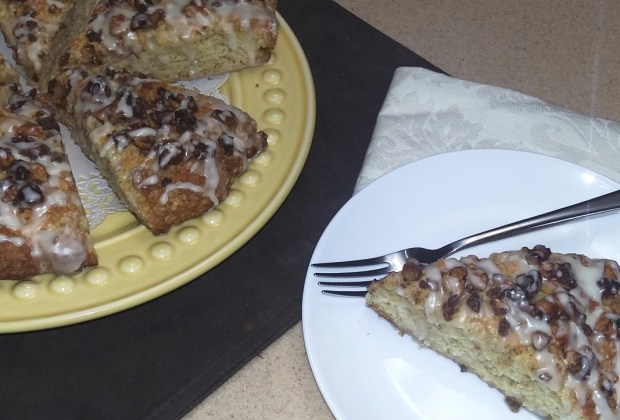


 There we all were clustered in front of ‘our’ bus (of which there were many), taking selfies, waiting patiently for the doors to open. As soon as they did, we piled in, jostling each other for the best seats. The tour leader boarded, introduced himself and we were off. We began at the stadium where tickets to Paul’s 2008 concert sold out in seconds to twice its capacity, when he played far into the night without ever taking a break. We then drove to the ‘neighborhood’ where the four young men grew up, visiting each individual location, the schools, the hangouts, the barber shop, the church where Paul was a choir boy … learning about all the inspiration for their songs. Along the way, the entire bus group would break out into song, everyone knowing the words, to the Beatles background music.
 The tour leader was not only entertaining, he provided us with so many rich details on each band member, making it quite an intimate experience. Starting from 1957 when 15 year old John Lennon started a skiffle band, to Paul McCartney asking his banjo-playing mother to teach him how to play the guitar, to Richard Starkey wearing a bunch of gold rings and earning the name “Ringo”, to Lennon wanting George Harrison in the band because “that kid can sing and he’ll get us all the girls”. And learning that the reason the Beatles broke up was not because of Yoko Ono, but because of the death of Brian Epstein, the cement which kept these talented four together.
 Two hours later, our tour ended back in the city center where it really all started for the Beatles, at the Cavern Club. This little below-ground club is where in 1961 the Beatles (before Ringo) played to the lunchtime crowd almost daily. Today this alleyway of a street is the hub for Beatles mania! The Cavern Club sits mid-way, but first there are Beatles gift shops selling absolutely every item you can imagine with Beatles images on them. Outside the Cavern Club is a brick wall with the name of every known country, rock or blues musician. And be sure to have your photo taken with John Lennon or Cilla Black.
 Each year Liverpool hosts an International Beatles Week attracting thousands of fans, with concerts all throughout the city performed by hundreds of Beatles tribute bands from around the world. And, if you are such an ardent Beatles fan that you want an all-consuming experience, then you must stay at the Hard Day’s Night Hotel. This high-end establishment is adorned with specially-commissioned artwork and memorabilia. And, yes, it serves Afternoon Tea.


 For most of us, caffeine really shouldn’t be a concern. High amounts of caffeine, however, can absolutely have a negative affect on some people. If you are on medication which is affected by caffeine, or if your doctor is asking you to cut caffeine out of your diet, switch to a decaffeinated tea or a caffeine-free herbal. (Remember, caffeine is not present in herbals unless they are blended with tea leaves.) Always consult with your doctor if you have any questions about caffeine’s effects upon your health.


 We then traveled south into the magnificent area of Andalusia with its vast savannahs filled with olive groves and vineyards, surrounded by the majestic Sierra mountain ranges. Our visits to the white-washed villages of Cordoba, Toledo, and Ronda were breathtaking … but no ‘tea’.
