
I was watching a re-run recently of one of the older Great British Bake Off episodes (yes, I do watch them over and over again) and the technical challenge presented by Mary was an “Angel Food Cake”. The contestants all appeared completely baffled by this challenge, but I smiled to myself, knowing that I had actually made one . . . a long time ago.
I remember it distinctly. It was 1972 and I had never made a cake before … a real ‘from scratch’ cake. The recipe was straight out of the only cookbook I owned (but don’t remember where it came from), the Better Homes and Gardens cookbook. My recipes generally came from  magazine and newspaper clippings – with pictures, of course, so that I would know exactly what the finished dish was suppose to look like.
You may have seen this classic cookbook on a shelf in an antique shop or used book store . . . a three-ring binder with a red and white gingham cover. This cookbook actually taught me how to cook and became my bible in the kitchen.
The cake was an Orange Angel Food Cake. There was no special occasion and I don’t really know why I selected this cake. Perhaps it was because I had a dozen eggs which were getting old and a bag of oranges which I didn’t want to go to waste. I also don’t remember how I had obtained an angel food cake pan, but I had one … and still do. So, following the instructions very carefully, I took on the challenge and remember being quite proud of myself when it came out . . . perfectly baked . . . light and fluffy . . . with a delicate citrusy orange flavor.
Have I made this cake since? No. And I’m not sure why. But after watching the GBBO episode, I’m feeling a bit nostalgic . . . plus I have a dozen eggs, a bag full of oranges, and an angel food cake pan. So, let’s give it a try!
ORANGE ANGEL FOOD CAKE
Preheat oven to 325°. Do not grease the cake pan. (Something the contestants did not know.)
8 eggs yolks
2/3 cup sugar
1 tablespoon grated orange peel
1/2 cup freshly squeezed orange juice
1 cup cake flour, sifted
8 egg whites
1 teaspoon cream of tartar
1/2 teaspoon salt
2/3 cup sugar
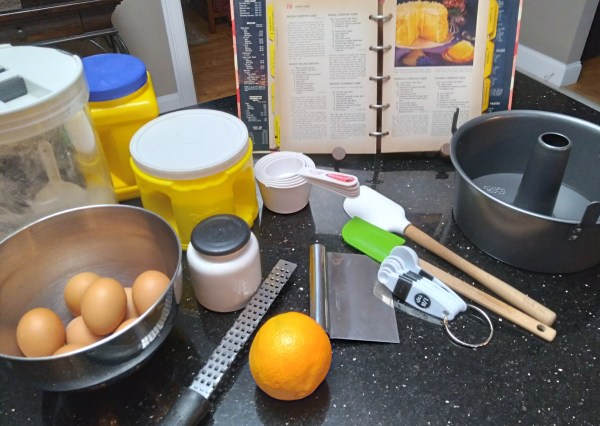
I always line up all the ingredients when baking. It’s so easy to forget something … and it could be as simple or important as salt.
 Separate 8 large, room-temperature eggs … put the whites aside.
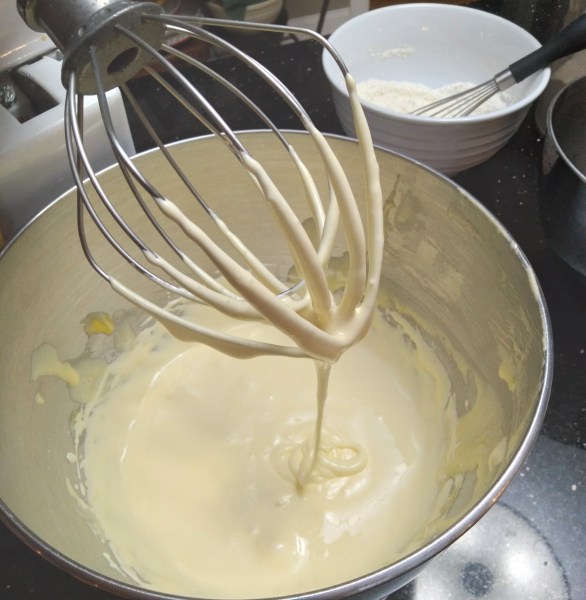 Beat the egg yolks until thick and lemony-colored. Gradually add 2/3 cup sugar. Beat until gloriously thick. Combine the freshly-squeezed orange juice (freshly-squeezed gives the best flavor) with the orange peel. Add this to the egg yolk mixture alternately with the cake flour. Set aside.
 Beat the egg whites with the cream of tartar and salt until the soft peak stage. Very gradually add the other 2/3 cup sugar. Beat on high until stiff peaks form … but do not overbeat. The egg whites should be stiff but not be dry.
 Gently fold the egg whites into the egg yolk mixture.
 Pour into the ungreased 10″ tube pan (or whatever pan you’d like to use). Angel food cakes do not need to be baked in a specific pan. Loaf pans are fine. Bake in a 325° oven for about 50 to 60 minutes.
 When done, a tester will come out clean, the sponge should spring back when touched and the color will be a delicate golden brown.
 Invert the tube pan to cool the cake. Yes, that is what the ‘feet’ are for. After approximately 20 minutes, the cake should easily come out of the pan. Turn right side up. Frost when cooled.
 Is it a “show stopper” as Mary would’ve liked to have seen? No … but I’m very happy with it. The cake is feathery light with just a subtle hint of citrusy orange. I made a quick seven-minute frosting and decorated it with candied orange slices.
This is the perfect cake for after a heavy meal when you want something sweet, but not too sweet or rich … or when you want to impress your guests (because they will be impressed). It may have taken me almost 50 years to make this the second time, but you know I’ll be making it again very soon! Yummy!!
_____________________________________________________________________________

 It was so confusing … but what I really wanted was a classic, cast-iron English AGA cooker. I’d be surprised if you’re not familiar with this icon of a cooker. For over 100 years, the AGA has commanded attention in most English kitchens, from the largest manor houses to the more modest cottages. Chefs including Marco Pierre White, Paul Hollywood and Mary Berry wouldn’t think of cooking on anything else. Jamie Oliver said AGAs “make people better cooks”. Food writer, William Sitwell, said using one was a “much more natural way of cooking”, and actor Gerard Depardieu describes his AGA simply as “fabulous”.
 Although there were many styles of British ranges being used, from wood to coal fired, they tended to be dirty, time consuming and, occasionally, dangerous. They had ovens to bake in and hot plates to simmer things on and they kept the kitchen toasty warm. For proper venting, the ranges needed to be installed into a fireplace opening. The biggest disadvantage was soot falling down the chimney into the food, and the amount of work it took to clean them. The range had to be cleaned every day, carefully removing the ashes and cinders, which were still combustible. The oven had to be swept out, and any grease which splattered needed to be scraped off. The flue needed to be cleaned constantly.


 Make the filling first by dissolving a packet of orange-flavored gelatin into 1/3 cup of boiling water. Spray or grease a 12 count muffin tin. Into the bottom of each cup put a tablespoon of the gelatin. Put the tin into the refrigerator for the gelatin to set. When the gelatin has set completely, remove each disc from the muffin tin and place on a dish. Place the dish back into the refrigerator until its time to assemble.
 Using a stand mixer or hand mixer, beat the eggs and sugar together for at least 5 minutes until delicate, pale and frothy. Sift together the flour, baking soda and salt. Carefully fold the dry ingredients into the egg mixture. Be careful not to deflate the eggs. Put 2 tablespoons of batter into the bottom of each of the greased muffin cups and bake at 350° for 7 to 8 minutes or until pale but baked through.
 Remove the muffin pan from the oven and let cool for a few minutes. Then remove each cake/cookie and let them cool completely on a wire rack. Meanwhile, over a bowl of very hot water, melt the chocolate chips, stirring as necessary until smooth and shiny. Let cool a bit.
 To assemble: take a cake/cookie and place an orange disc on top and quickly place a spoonful of the chocolate on top of the disc. Using the back of a spoon, spread the chocolate, sealing in the orange wafer. Place the cookie back onto the rack. When they are all assembled, using the tines of a fork, gently make a criss-cross pattern on each of them*.
 They may not be as pretty as Mary Berry’s Jaffa Cakes, but they taste pretty darn good. Tasty little cakes with an orange filling and chocolate frosting. If you wanted to make these ahead, I’m sure they’d probably last a few days, but definitely not in our house!
 Has anyone else noticed that the bakers are younger, more stylish, and dare I say, more attractive? In past seasons, there was a wide range of ages. But not so much any more. Where’s the Val, Diana, Brendan, Norman and Nancy today? Is this home baker now too old for the commercial Channel 4 audience? Also, these much younger contestants, with their perfect teeth, coifed hair and slim bodies appear to be in ‘character’ now … much like MasterChef.




 The judges, Mary Berry and Paul Hollywood, somehow work beautifully together … a bit like Julia Child and Jacques Pepin. Paul, with his piercing blue eyes, would intimidate even the most seasoned baker. It just takes one look for you to know you’re doomed, but Mary (30 years Paul’s senior) finds some good in every bake, regardless of how awful it may look or taste. Both Paul and Mary are hugely successful professional bakers, cookbook authors, and television personalities, each with their own cooking shows; but there are no signs of egos here. Each week they bring interesting and quite difficult challenges to the contestants, after which they focus on the ‘bake’, nothing more. How refreshing!
 The baking “challenges” are divided into three categories. First , there is the Signature Bake, to test the contestants’ creativity and baking ability. Next is the Technical Bake, where the bakers receive a recipe from Mary or Paul with minimal instruction. Finally, it’s the Showstopper Bake, which is designed to display the bakers’ skill and talent. Many of these “challenges” are classic British baked items, some are from French patisseries … most of which I have never ever heard of (actually some of the contestants have never heard of them either). Yes, the contestants are given recipes in the Technical Bake, and, yes, they have advance knowledge of what the next challenge is going to be so that they can practice at home. What they don’t have to do is try to utilize canned chicken, root beer, squash blossoms and dill pickles to make a frozen dessert. This is a true baking show, remember. Gimmick free!
 I did my research, downloaded the map, the schedule of events, and was ready. We took a drive to Bishop Auckland the day before just to get the ‘lay of the land’. I certainly didn’t want us to get lost, or not know where to park. As we drove along the highway into Bishop Auckland, the flashing signboards were up warning us to “expect delays” because of what was expected to be thousands upon thousands of foodies descending on the town. We talked to relatives who kindly offered their driveways, knowing that we’d be driving around for hours trying to find a spot to park the car.