
Who thinks of “gingerbread” in April? In America, “gingerbread” doesn’t seem to enter our thinking until the holidays start approaching. And even then, we tend to think of gingerbread only in the form of gingerbread men cookies and gingerbread houses. In the U.K. and throughout Europe, however, gingerbread is available, purchased, baked and enjoyed year round. This may be of no interest to anyone, but I find it fascinating.

Illustration depicting Christopher Columbus’s fleet departing from Spain in 1492.
We’re all familiar with ginger, even if its only in the dried, powdered form. But did you know the ginger plant, from which we use the root, was discovered in the Indonesian islands, along with many similar plants, as early as 2000 B.C. Knowing its medicinal benefits even then, ginger was already being cultivated by the indigenous people. Along with turmeric, cardamom, cinnamon and cassia, ginger was among the first spices to be transported from the Far East over land and by sea to the Middle East and Europe.
From burning the spices in religious ceremonies, to creating ointments and potions to ward off the plague, as well as to hide putrid household smells and make unpalatable food edible, spices were in high demand. We all know Christopher Columbus was trying to find a shorter route to the spice islands when he ‘bumped’ into this land mass. The trade routes were so coveted, battles were fought over them and spice merchants became extremely wealthy and powerful. Ginger was so expensive n the Middle Ages, one pound was the same price as one sheep. But once the trade routes became established during the 15th and 16th centuries, prices stabilized … and by the 17th century, the Spanish were able to cultivate ginger and were growing it in the West Indies, making it affordable for all.
So, now that we know where ginger came from, let’s find out where “gingerbread” came from and why it’s so important in European cuisine . . .
 I’ve read that the first known recipe for ‘gingerbrede’ came from Greece in 2400 BC. Really? How do they know that? I do know, however, that food historians have traced ginger as a seasoning since antiquity. From my research, it seems an Archbishop from Armenia, in the 1st century, is credited with serving his guests a cake made of spices. By the tenth century, its proven that Chinese recipes for ‘spice breads’ were developed using ginger, and by the 13th century European nuns in monasteries were known to be baking ‘gingerbredes’ to ease indigestion. As spices, and in particular ginger, made their way throughout Northern and Western Europe, these breads baked in monasteries became so popular professional bakers began to make them. The ingredients, of course, were a bit different from what we would expect. Ground almonds, breadcrumbs, rosewater, sugar and ginger were mixed together and baked. It wasn’t until the 16th century when eggs and flour were added.
 Did you know Queen Elizabeth I is credited with creating the first “gingerbread man”? Known for her outlandish royal dinners, Queen Elizabeth employed a ‘Royal gingerbread baker’. Among her array of fancy desserts were not only birds, fruits, and castles shaped out of marzipan, but also of gingerbread. The first documented gingerbread-shaped biscuit actually came from the court of Queen Elizabeth when she commissioned figures to be made in the likeness of some of her important guests. They were the hit of the court and soon these biscuits made their way into the bakeries.
Still not an inexpensive treat, gingerbread became widely popular at Medieval fairs all over Europe. They were sold not only as delicious snacks, but as souvenirs and good luck charms. Gingerbread became so popular, cities in France and England began holding “gingerbread fairs” and even formed Gingerbread Guilds, with strict baking guidelines and competitions. Nuremberg, Germany was actually recognized as the “Gingerbread Capital of the World” and the quality of their gingerbread was so high that it was even used as currency for paying city taxes. The oldest recorded gingerbread recipe, dating back to the 16th century, is on display in the Germanic National Museum in Nuremberg.
 Elaborately decorated gingerbread became so synonymous with all things fancy and elegant that the Guilds began hiring master bakers to create works of art from gingerbread. Bakers began carving wooden boards to create elaborately designed molds to shape individual images. The shapes included not only flowers, birds, and animals, but even people. They were in such demand, kings and queens, lords and ladies, knights and bishops wanted their images captured in “gingerbread”. Should a young woman want to improve her chances of attracting a husband, she would have a “gingerbread man” made for her in the likeness of her gentleman’s image. The hope was that if she could get him to eat the spicy delicacy, he would then fall in love with her. Decorated gingerbread was given as a wedding gift, or to celebrate a birth or special occasion.
Gingerbread became such a specialized and highly prized item, only professional ‘gingerbread’ bakers were allowed to make it, unless, of course, it was a holiday such as Christmas or Easter, then anyone would be given permission. The gingerbread house, as we all know and love, was created in Germany to replicate Hansel and Gretel’s foray into the woods. Can we say Brothers Grimm? This tradition of creating gingerbread houses at Christmastime is as strong today as it was 300 years ago.
In England, the small town of Market Drayton has been making gingerbread since the 1640s, and by 1793 had four gingerbread bakeries. The town is so proud of its gingerbread heritage its displayed on their welcome sign.
 In many European countries, gingerbread is still considered an art form, and the antique mold collections are on display in many museums. According to the Guiness Book of World Records, the largest gingerbread man was made in Norway in November 2009 and weighed 1,435 lbs. And the largest gingerbread house was made in Texas, November 2013 by the Traditions Club – 60 ft. long, 42 ft. wide and 10 ft. tall – all to raise money for St. Joseph’s Hospital.
Whether you enjoy your gingerbread soft and chewy, as a crispy biscuit, or as a dense cake sweetened with molasses or honey, this tummy-warming treat is hard to resist. Now that I’ve uncovered these little known facts about gingerbread, I think I better understand why its so popular in Europe . . . from Norway to Switzerland, Poland to Germany, Bulgaria to England, gingerbread is available, loved, and eaten year round, and not just at Christmastime.
As Shakespeare said, “An I had but one penny in the world,
thou should’st have it to buy ginger-bread…”
~ ~ ~ ~ ~
References: Britannica, Unesco, Vegetable Facts, Wikipedia, Confectionary Chalet, BBC,
____________________________________________________________________________


 Make the filling first by dissolving a packet of orange-flavored gelatin into 1/3 cup of boiling water. Spray or grease a 12 count muffin tin. Into the bottom of each cup put a tablespoon of the gelatin. Put the tin into the refrigerator for the gelatin to set. When the gelatin has set completely, remove each disc from the muffin tin and place on a dish. Place the dish back into the refrigerator until its time to assemble.
 Using a stand mixer or hand mixer, beat the eggs and sugar together for at least 5 minutes until delicate, pale and frothy. Sift together the flour, baking soda and salt. Carefully fold the dry ingredients into the egg mixture. Be careful not to deflate the eggs. Put 2 tablespoons of batter into the bottom of each of the greased muffin cups and bake at 350° for 7 to 8 minutes or until pale but baked through.
 Remove the muffin pan from the oven and let cool for a few minutes. Then remove each cake/cookie and let them cool completely on a wire rack. Meanwhile, over a bowl of very hot water, melt the chocolate chips, stirring as necessary until smooth and shiny. Let cool a bit.
 To assemble: take a cake/cookie and place an orange disc on top and quickly place a spoonful of the chocolate on top of the disc. Using the back of a spoon, spread the chocolate, sealing in the orange wafer. Place the cookie back onto the rack. When they are all assembled, using the tines of a fork, gently make a criss-cross pattern on each of them*.
 They may not be as pretty as Mary Berry’s Jaffa Cakes, but they taste pretty darn good. Tasty little cakes with an orange filling and chocolate frosting. If you wanted to make these ahead, I’m sure they’d probably last a few days, but definitely not in our house!


 First, warm the milk in the microwave (not too hot) and stir in the yeast and the sugar. Let it rest for 10 minutes until its frothy.
 In a large bowl, stir together the flours and the salt. Add the warm milk mixture and stir together until a thick dough forms. If using a stand mixer, use the paddle attachment. Let it mix for about 3 or 4 minutes.
 No need to take it out, knead it and grease the bowl. Just cover the bowl with a towel and put it aside to rise for about an hour, or until the dough has doubled in size.
 When it has doubled and will hold an indentation from your finger, it’s ready. Mix together the cup of water with the baking soda. Now comes the tricky part, mix this liquid into the dough. It’ll be difficult at first. I used a fork to break the dough up, and then beat the mixture with a wooden spoon until it was somewhat smooth (but not perfect … still a bit lumpy).
 Using a ladle or tablespoon, spoon equal portions of the batter into the molds. The batter will be sticky and gloppy. Don’t be concerned. That’s how it’s suppose to be. Keep an eye on the heat to be sure they don’t burn on the bottom, turning it down as necessary. They will rise and as with pancakes, they will be almost fully cooked before they need to be flipped over (about 6 minutes on the first side). When the top has lost its gloss and the sides look firm, remove the rings. The rings will be hot, so use tongs. With a spatula, flip the crumpets over and let them cook on the other side for just another minute.


 A Chatelaine is nothing more than a “key chain” … a key chain most often worn by women heads of households, but also some men, from early Roman times through to the 19th century. During this period, women’s clothing did not have pockets, and women did not carry handbags. Unthinkable, I know. So where did women (and some men) keep the keys to the larder or the tea chest? What about those small embroidery scissors or their watch? Not to mention their snuff box or perfume vial. This very practical accessory, the Chatelaine, would hold all of these and other essential items, which a head of house, a nanny, or nurse might need at a moment’s notice.

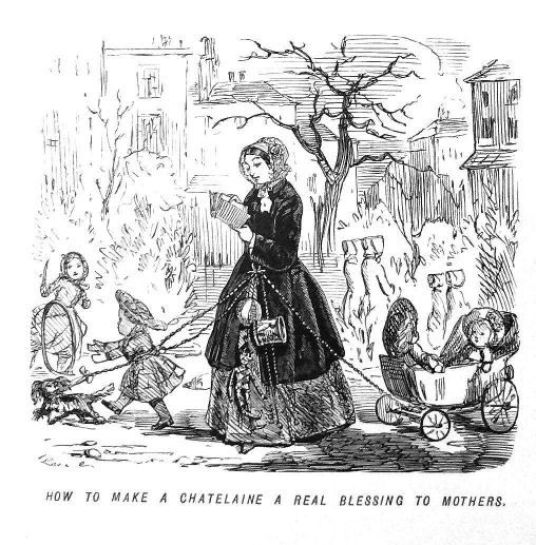 Punch, a very influential 19th century British weekly magazine, notorious for their sophisticated humor and satire (and is known for creating the “cartoon”), came up with an interesting use of the Chatelaine to aid mothers of young children
 As I mentioned above, Chatelaines are actually still very popular. Today’s Chatelaine may look a little different and some may be purely decorative, but not all. How many of us wear a Lanyard to hold our eyeglasses or company badge? This very practical accessory, the Lanyard, is also a modern day form of a Chatelaine.
 First, line up all your ingredients. Don’t be one of those bakers who goes looking for things as you go along. If you have everything in front of you, you’re less apt to make a mistake and forget something. Then, preheat your oven and prepare your pan. Most ovens take 20 minutes or more to heat up thoroughly. A $5.00 oven thermometer is a great investment and saves a lot of baking disasters.
 In a large bowl (or food processor) add the dry ingredients. Mix well or pulse two or three times. Cut the icy cold butter into cubes and add it to the dry ingredients until it resembles fine crumbs. Again, if using a food processor, PULSE 10 or 12 times … no more!
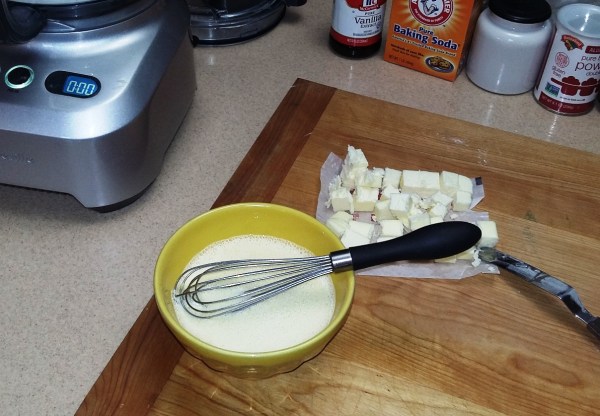 In a small bowl mix together the egg, milk and vanilla. Then add this wet mixture to the dry mixture. Stir it in with a fork or PULSE a few times just to combine everything.
 Turn the mixture out onto a floured board. Knead a few times to bring it together. Do not overwork the dough or your scones will be tough and won’t rise properly.
 Form the dough into a round and with a rolling pin, gently roll until you have about 3/4″ thickness. Cut the dough into triangles (or you can use a cutter to cut out shapes). Place the triangles onto a parchment lined baking tray.
 In another small bowl, mix the chopped nuts, sugar and cinnamon. Sprinkle over the scones, pressing down lightly to fix them onto the scones. This is completely optional.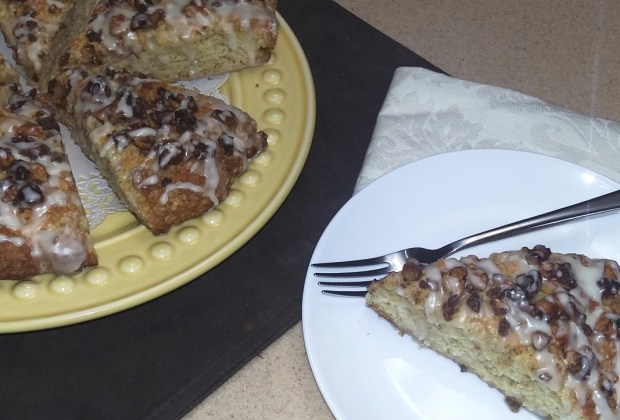


 Let’s start at the beginning. Although the British had been ruling Ireland since the takeover in the 12th century, Brits did not live there, preferring to be absentee landowners. In Ireland, cattle were beasts of burden and unless they were old and not able to plow the fields, or the cows to produce milk, they were not slaughtered. Cattle was a sign of wealth and the only time one might be slaughtered was if there was a festival or celebration. And, even then, it was only the wealthy English landowners who could afford to part with this valuable beast of burden. Pigs were, and still are, the most prevalent animal raised to be eaten.


 The cabbage, potatoes, turnips and carrots are traditional, but the Jewish-style brisket is definitely American born. To celebrate St. Patrick’s Day, Irish Americans today (and those wanting to be Irish) will pin a shamrock on their lapel, order a green beer and enjoy Corned Beef and Cabbage. From high-end, fine dining restaurants to local mom and pop diners, on kitchen tables and celebrations across the country, we’ll all be tucking in to this homespun dish. You still, however, won’t see it served in Ireland.
 Coal mining, or “black gold”, played a huge part in the Industrial Revolution in Britain. Wood was in short supply by the 19th century and coal was needed to fire the blast furnaces for the iron and copper industries. The dangerous job of mining coal was the center of discontent for most of its workers. Uprisings against employers were commonplace. Although the Factory Act and Mines Act were passed, which were meant to prevent women and children under the age of 10 from working underground, they were by and large, ignored. Accidents, long-term health problems and other catastrophes continued.


 Add the cubed fish and fold in gently. You don’t want to break the fish up. If you have leftover boiled potatoes, add them now … or any leftover veggies you may have. Turn off the heat and dump everything into a large casserole or pie plate.
 Take the pastry out of the frig and, on a lightly floured board, roll it out to fit the casserole or pie plate. Be sure to cut an air hole in the center of the pastry for the steam to escape.
 Be sure to put the casserole onto a baking tray to catch any spillage … and there will be spillage. Bake at 425º for 40 to 45 minutes until golden brown and bubbly.


