
I’ve been hearing the name “JAM ROLY POLY” for years but have never been quite sure what it was. I thought it might just be a silly name for an English version of a jelly roll cake or a rolled pastry filled with jam. With a name like that, it definitely has to be a children’s dessert, right? Well, I was partly right. What I’ve learned is that, not only was it one of hubby’s favorite school foods which tugs at the heart strings of most Brits, it has a fascinating history.
If you search online, as I did, for JAM ROLY POLY, you’ll find unappetizing names like ‘dead man’s arm‘ or ‘dead man’s leg‘, and ‘shirt sleeve pudding‘ which just didn’t provide much information and only continued to confuse me. To learn more about this strangely named childhood favorite, I actually had to go all the way back to Great Britain’s Industrial Revolution.
The Industrial Revolution began in Britain around the latter part of the 18th century with the invention of the steam engine. Up until that time most goods were made by craftsmen and power was created by water or animals. Now with the advent of the steam engine, machinery and technology became the catalyst for mass production. Before long, an increase in global trade created a greater demand for these manufactured goods and factories were built in all the urban areas.
Inventors were creating more and more machinery to push productivity. Coal now became a major player to fuel the engines. The critical element necessary for success to operate all of this machinery was, of course, people. Three quarters of Britain’s population, at that time, were craftsmen and farmers who lived in the countryside. But with these rural cottage industries closing, they had no choice but to pack up and move to the cities in search of jobs.

Although British productivity soared, the overwhelming competition for jobs kept the wages low. Some individuals became very wealthy. Too many people, however, lived in overcrowded slums with little or no food or comforts. With so little income, parents had no choice but to send their children to work in the factories as well. Children were welcomed by the factory owners and managers, not only because they were cheap labor, but because their small statures and nimble fingers made them suitable for many work situations.
Prior to this time, education was not free. Poor children eked out whatever education they could. In 1833, the government passed the Factory Act, the first of many legislative attempts to improve conditions for children working in factories. In addition to limiting the hours a child could work, this Act made mandatory two hours of education a day. This did not, however, ensure that these rules would be followed. Children were wage earners and to have them attend school and not work placed a huge financial burden on the family. Charles Dickens and Thomas Hardy captured the brutality of this era in the storytelling of David Copperfield and Oliver Twist.

In 1844, the Ragged Schools Union was set up to provide free education to poor working class children. The success of these “ragged schools” demonstrated that there was a demand for education among the poor and in 1870 public funding began to be provided for free elementary education. Although Britain’s economy was flourishing, the health of its people was not. One third of its children were malnourished. Infant mortality was on the rise. Men were deemed not fit to serve in the Armed Services. But it wasn’t until 1889 when a report was published which indicated that over 50,000 pupils in London alone were attending school without having eaten anything at all which prompted two school board members to take action. Margaret McMillan and Fred Jowett persuaded Parliament to introduce legislation which would encourage free school meals for children.

Mrs. Macmillan was passionate about improving the welfare and education of children and encouraged others to see children as the future of the nation. Her belief was that children couldn’t concentrate on their lessons because they were starving. Although charities had been feeding the hungry for years, a formal program was now put in place to feed schoolchildren.
Breakfasts for the school children consisted of bread with jam and milk. Lunch (or dinner as it is called in Britain) consisted of a porridge or stew, pudding, bread and butter and milk. Puddings have been an integral part of the British diet since the middle ages. They began as a savory item made with suet to bind all the ingredients together and then steamed in muslin cloth (hence, the reference to ‘shirt sleeve pudding’ or ‘dead man’s arm’).
A typical school lunch program from the early 1900’s:
Monday: brown vegetable soup, jam roly-poly pudding, sauce;
Tuesday: savoury batter, beans, gravy, semolina pudding;
Wednesday: potato and onion soup, ginger pudding, sweet sauce;
Thursday: stewed beef and gravy, mashed potatoes, baked jam roll;
Friday: fish and potato pie, parsley sauce, peas, sago pudding.
 As you can see, meals had to be inexpensive, filling and something the children would eat. To get them to eat the more nutritious porridge or stew, a sweet “pudding” was always served. The one they liked the most … JAM ROLY POLY!
A roly-poly is a pudding made with a suet dough, which is then spread with raspberry or strawberry jam, rolled up, tied in a muslin bag and boiled or steamed. First published in 1861, Mrs. Beeton’s Book of Household Management included a recipe called jam roly-poly pudding and so began the British love affair with this sweet, stodgy pudding served with lashings of hot custard.
Now that we’ve uncovered the origins of the JAM ROLY POLY, do we really want to make one? Maybe … maybe not!
~ ~ ~ ~ ~
References: Health.co.uk, Wikipedia, BBC, National Archives, Intriguing History, British Food History, the Nosey Chef, Food Timeline, Economic History Association
_____________________________________________________________________________


 them in British import stores. They can be a bit pricey, but if cooking is not your ‘thing’ or you don’t have time, be sure to pick one up. They are delicious!
 Cut the pound of dried fruits up into even-sized pieces. Kitchen shears or scissors is the easiest way to do this. Make sure all the pieces are about the same size.
 Put the mixed fruits into a bowl and pour the liquor over. Mix well, cover and let steep overnight or up to a week. I used a sweet liquor made from the tamarind fruit. Soooo good!
 The next day, or later that same day, combine the dry ingredients and spices in a small bowl. In another bowl, mix together the brown sugar, orange peel, orange juice, honey and melted butter.
 Beat in the eggs one at a time. The batter will appear to have curdled. Not to worry. Add the dry ingredients and mix well.
 When combined, add the steeped fruits and nuts and mix to combine thoroughly. If the batter is too wet, add more flour. Now you can add the “lucky charm”. Put a large pan of water or steamer on to boil. Place a saucer in the bottom to keep the pudding mold from touching the bottom of the pan. Generously grease the pudding mold(s).
 Pour the batter in the prepared mold or bowl, pressing the mixture down and tapping it to get rid of any air bubbles. Then wrap it with a layer of parchment paper and foil so that it is completely watertight. It will rise a bit and needs room at the top.
 It’s also important to trim away any excess parchment paper and foil. You don’t want any steam traveling into the mold and making your pudding soggy.
 Put a small plate upside down inside the pan to keep the mold/bowl from touching the bottom of the pam. Then place the mold into the pan of water. The water should come at least halfway or more up the side of the bowl or mold.
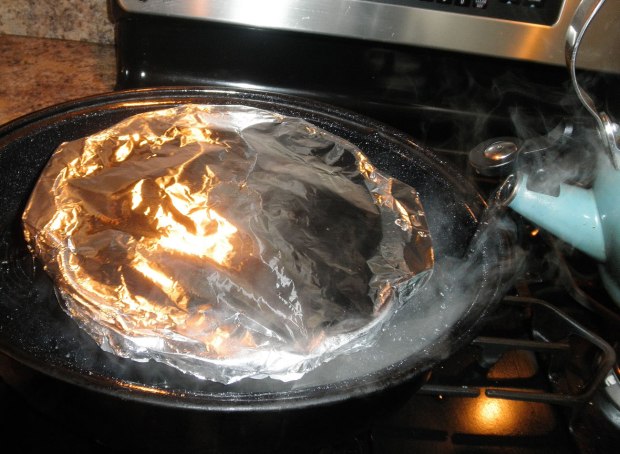 Bring the water to a boil, cover tightly and steam for 5 to 7 hours, checking every now and again to make sure the water hasn’t bubbled away. The longer you let it steam, the darker it will get. After 5 to 7 hours, remove the mold carefully and let it cool completely. Discard the paper and foil and rewrap with fresh. Store in a cool, dry place or the refrigerator for up to four weeks.
